


Photographer Raghu Rai (1942–2026)
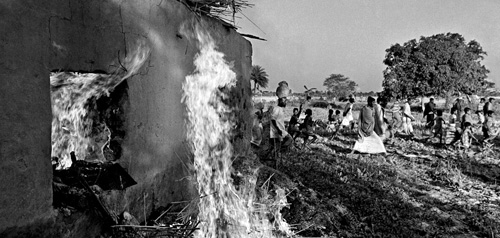
Helpless Bangladeshis saw their homes being reduced to ashes by their Muslims brothers whom they handed their post-colonial destiny. Bangladesh. 1971. © Raghu Rai / Magnum Photos
With close access to India’s first and only female Prime Minister, Indira Gandhi, Rai captured the upheavals of her first term from 1966 until 1977, including the Emergency period, followed by her surprising return to office in 1980, her assassination in 1984, and the day of her cremation. Rai’s portraits trace a timeline of her political rises and falls, alongside intimate moments in her private life, which help understand the complexity and controversy of her life story.
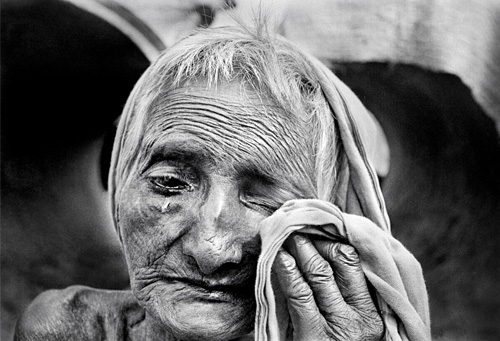
Bangladesh. 1971. © Raghu Rai / Magnum Photos
Rai wrote: “Political analysts, politicians, and commentators have their own understanding of this complex and chaotic time, but being an instinctive person, I look at it from a more human angle.” He added, “When I started doing this, I realized that if someone in the future didn’t know who she was, and what a strong personality she was, what a tough leader she proved to be, perhaps they would realize that by looking at these photographs. I began to ask myself, does this picture stand the test of time by itself, for itself? These pictures of her capture some of her essence.”
Also in the late 1970s, Rai began photographing the Dalai Lama, who he would continue to portray until 2015. His 1991 book Tibet in Exile opens with a foreword by the Dalai Lama, recording the life of the Buddhist leader alongside his community living in exile in India.
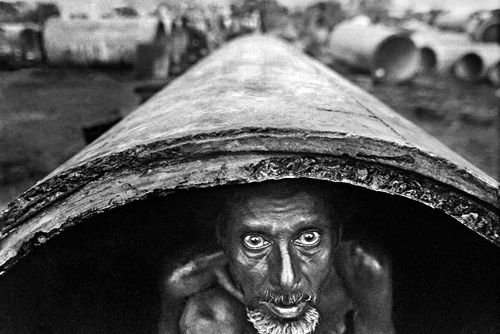
Bangladesh. 1971. © Raghu Rai / Magnum Photos
Rai continued his career in 1980 as a picture editor and photographer for India Today, India’s leading news magazine, which he found to be a “very productive and meaningful” role. From 1982 to 1991, he cultivated special issues and designs, contributing trailblazing picture essays on social, political and cultural themes, many of which became the talking point of the magazine.
On December 3, 1984, the worst industrial catastrophe in history to date took place: a gas leak from Union Carbide’s pesticide plant in Bhopal, India, intoxicating half a million people and killing up to 10,000 people within the first few days, while thousands died from complications in the aftermath. Rai was one of the first on the scene to document the disaster. “I was in bed at home in Delhi when my editor at India Today magazine called me in the middle of the night. His call was swiftly followed by one from Magnum’s Paris office,” Rai recalled in an essay for Amnesty International.
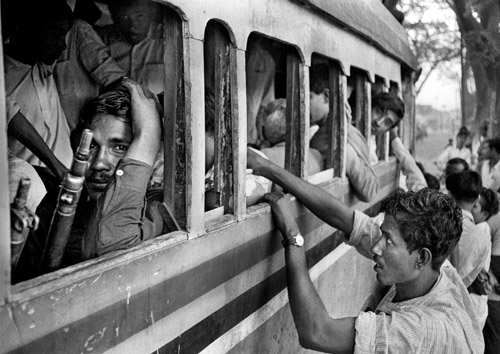
“When we got to Hamidia hospital the chaos was overwhelming. I had never seen anything like it, it was as if a war had just ended or in the aftermath of an earthquake. [...] There was a strange kind of silence - the silence of death,” he wrote. “No matter how many shots I took, I couldn’t capture the scale of it.”
“No matter how many shots I took, I couldn’t capture the scale of it.”
- Raghu Rai
His images of Bhopal resulted in a book and three exhibitions that have toured Europe, America, India and southeast Asia since 2004, the 20th anniversary of the disaster. Rai’s hope was that the exhibition can support the many survivors through creating greater awareness, both about the tragedy and its victims.
Three decades later, in 2014, on assignment for Amnesty International, Rai returned to the site, photographing communities still living with the environmental and health consequences of the incident.
“Still images are here to stay as an experience that is so powerful and a moment so potent that it is tangible.”
- Raghu Rai
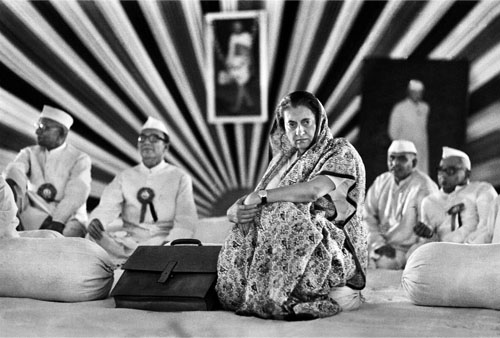
Indira Gandhi at a congress session. Delhi, India. 1966. © Raghu Rai / Magnum Photos
In the late 1980s, Rai published Calcutta, a black-and-white portrait of the capital of West Bengal, evoking its multiplicity, rhythms and rituals, from the banks of the Hooghly River to streets pulsing with buses and vendors.
His three photobooks on Delhi, the photographer’s home and passion for 40 years, document the city’s rapid evolution that encapsulates, as he writes, “a photo-history that cannot be written.”
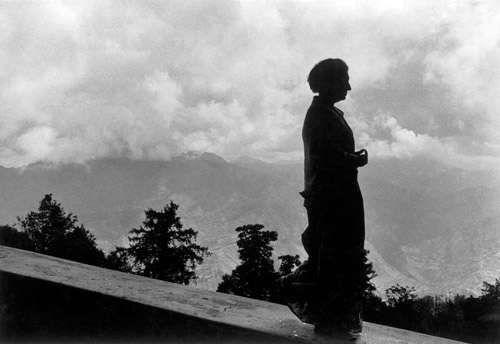
Indira Gandhi on the Himalaya mountain. India. 1973. © Raghu Rai / Magnum Photos
While much of Rai’s most recognizable photography is in black and white, he produced a voluminous and wide-ranging body of work in color, seeking to capture the multitude of human interaction.
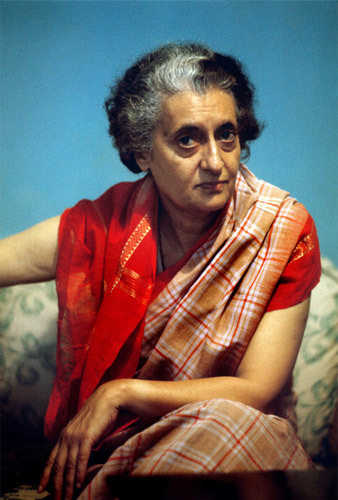
Former Prime Minister Mrs Indira Gandhi. © Raghu Rai / Magnum Photos
In his book Raghu Rai’s India - Reflections in Color, he writes, “Many of the precious treasures of our civilization - human relationships, values and simple interactions of daily life - are going through major changes. This is precisely what I am talking about, to bring man closer - face to face with human reality, quite unlike television screens where images come and disappear as a flickering experience - but still images are here to stay as an experience that is so powerful and a moment so potent that it is tangible.”

|

The Bombay Bicycle Club |
LATEST GALLERY IMAGES

Samm Henshaw 
Jessie Ware |
|
|